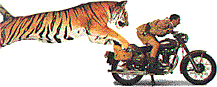
This is what happens to people who mistreat their Enfields.
Be warned.
So, maybe you're interested in owning one of these wonderful motorcycles ?
Don't let me put you off.
Despite the 'problems' I still have mine.
I ordered my 500cc Bullet back in 1991, when they were first released in Britain. I specified the option of a front disc brake, knowing that the standard twin leading shoe item was not all that spectacular when it came to stopping. After waiting 51 weeks, the bike finally arrived. I picked it up and only got as far as the shop car park before the complete twist grip and front brake lever assembly fell off ! So much for pre delivery inspection. This was not the fault of Enfield, but due to the incompetence of the dealer. Having got the bike home I proceeded to check it from front to back, just to see what else the dealer had managed to miss. The only other 'little' fault was the side stand spring which managed to snap within the first 25 miles.
I noticed, during the 'running in' period, what I took to be a tappet rattle. So without further ado, I checked the valve clearances. No problem there, but the rattle continued. I then removed the 'top end' from the engine and found the cylinder bore to be 'conical'. There was about 0.015" difference between the bore diameter at the top and the bore diameter at the bottom. The rattle was serious piston slap ! Seeing as the bike was still under warranty, I took it back to the dealer and explained what I had found. "No problem. Leave it with us and we will obtain another barrel and fit it" It took them over three months to carry out the warranty work, and when I did eventually go to pick up the bike I discovered that it had been left outside for those three months and was now a rusty heap. Also, for good measure, the throttle cable had been routed on the outside of the petrol tank, the tappet gaps were set at almost a sixteenth of an inch and the oil tank was overfilled. Shall we say that by now I had lost what little confidence I had with this particular dealer and was glad the six months warranty period was over. At least I could now work on the bike myself, even if I did have to buy the necessary parts.
The next thing was to change some of the original parts for 'better' ones. The main things being the carburettor, exhaust system, rocker arm assemblies and the gearbox sprocket. The gearbox sprocket in particular made a vast difference. The bike is way under geared for use on British roads. The existing carburettor was replaced with an Amal Concentric, which certainly improves the breathing of the motor. I had to make a 'new' inlet manifold in order to get the Amal to fit correctly, but it didn't present that much of a problem.
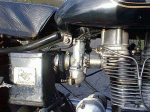
Click on the images for a full size view.
The original silencer was swapped for a 'Gold
Star' pattern, which although was a vast improvement, was far too
noisy. A 'cigar' pattern item soon followed, and that is still in
use now. A set of forged rocker arms and alloy pillow blocks soon
followed, along with the removal of the voltage regulator-cum-rectifier.
The latter item being replaced by a Zener diode and a silicon
block rectifier, which not only gives more efficient charging,
but is a far sight cheaper to replace should anything go wrong. A
set of 'hard luggage' was soon added, and the Enfield seemed
happy.
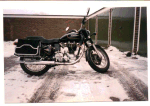
The Enfield in the snow.
Note the original exhaust, carburettor and front disc brake.
Not being a great fan of chrome, the next step was to get all the 'shiny' bits powder coated. A local firm did an excellent job of powder coating the wheels, handlebars, luggage rails, and all the other little odds and ends that needed doing.
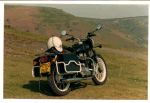
The Enfield with powder coated wheels and "Goldie" silencer.
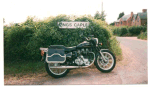
The Enfield enjoyed a few thousand miles of trouble free running before the gremlins struck again. I noticed that some of the powder coating had come off the wheels. I took them back to the coaters, and they said "Leave them with us for a few days and we'll re-do them. No charge" Well, you can't say fairer than that. When I returned to pick up the wheels, there was a *slight* problem. It seems the wheels had been sent to a 'stripping specialists' in order to have the existing powder coating removed. These 'specialists' didn't realize the hubs were made of aluminium and left them in the stripping vat far too long. The result was a pair of hubs that resembled Swiss cheese. Both front and rear hubs were scrap ! Then the fun started. I tried everywhere to obtain a disc brake front wheel for an Enfield. No one, including the factory seemed to have them. This meant that the only option left was to fit a drum braked front wheel. To cut a long story short, the bike was off the road for twelve months and the stripping firm ended up with a bill for new fork legs, new mudguard, new wheel, new twist grip / brake assembly, new rear hub and all the other little bits and pieces that make up a 'front end'.
March 2001, and the front disc makes a dramatic come back. Click below.
The bike's next little trick was to strip the
teeth from its oil pump drive spindle. This resulted in the big
end bearing failing - 120 miles from home - but the bike managed
to 'limp' back, sounding more like a diesel engine. A 'bottom end'
rebuild, and we were back on the road again. The little end,
feeling somewhat jealous of all the attention that the big end
was receiving, decided to seize solid. Whilst repairing the
little end, I treated the bike to a new aluminium cylinder barrel,
which weighs a whole nine pounds less than the original cast iron
item. A new seat was also fitted, the original was just a bit too
low for my long legs.
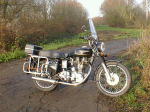
The Enfield as it is now. December 1999.
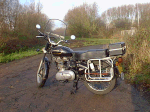
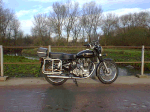

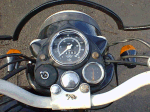
So perhaps my
little 'horror story' has put you off owning an Enfield? It's not as bad as it
seems. Although some of the above problems would be both expensive and serious
if they happened to a Japanese bike, with the Enfield it's far less of a
problem. The engine is delightfully easy to work on and the cost of the bits are
cheap. Despite what I've said, my Enfield has only had to be bought back home by
trailer once ! For sheer enjoyment, it's worth every penny I've spent on it. The
only *snag* I haven't sorted out yet is the footrest position, they're a little
too far forward for me, but there again, I've always been an awkward sod.
Right - it's now October 2007 - so time for a bit of an update.
Some sixteen years have passed since I first bought my Bullet. The saga of the dissolved front wheel is history. The rear wheel was rebuilt with an eighteen inch rim, which is what I said I would do. The Bullet enjoyed a good few years of running around, but the Indian made main bearings started to rumble. OK, so it took twelve years before they failed, but I couldn't live with my bottom end making all manner of strange noises ( nothing new there then, I hear folks say ). Whilst changing the mains, I thought I might as well get all the cycle parts powder coated seeing as the great rust demon was setting in.
The first little problem came when I went to remove the cylinder head. Bullet heads do not like to be removed - time for a little creative engineering, or bodging, as we call it. Kindly click below for instructions on decapitating Enfield Bullets.
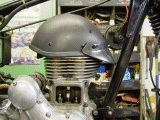
OFF WITH HIS HEAD - click on the picture for instructions.
Having persuaded the head to come off, the rest of the engine soon fell victim to my spanner monster.
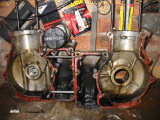
CRANKCASES
A great pile of parts were then sent away for blasting and powder coating.
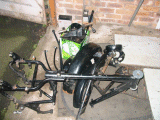
A GREAT PILE O' BITS
Now being an idle sort of a person, it took me almost two years to get around to actually putting the Bullet back together again. I added a rather comfy seat, and the Bullet was at one with the world once more.
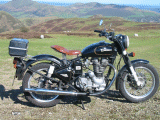
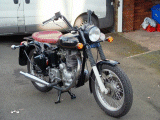
BULLET AND COMFY SEAT THE BULLET LIVES AGAIN
The Isle of Man - 2007
or how to knock the bottom end out of a Bullet.
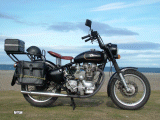
THE BULLET - WITH A SHOT BIG-END BEARING
I decided to take the Bullet over to the Isle of Man for the Manx G.P. week. The goings on can be found HERE, but don't forget to use your 'back' button to return here. In true Sod's Law fashion, something started to knock whilst going up the mountain. Oh dear, it seems the floating bush is sinking. Yes, the big-end had gone. Now seeing as the Bullet has a rather strange bearing arrangement, it was possible to continue using the bike for the rest of the week - some 650 miles or so with a shot big-end. If you must have a big-end failure, then the Bullet is one of the best engines to suffer it on. After much deliberation, I decided to spend almost as much as the bike cost, and rebuild the engine with a long throw British crank, a five speed gearbox, a forged piston, a roller bearing big-end, high delivery oil pumps, neoprene worm drive, new oil pump spindle, new alloy rocker blocks, new push rods, etc. etc. These, along with a big valve cylinder head and a new 32 mm carb, which had been fitted a few months earlier, should go a long way to making the Bullet a bit more lively.
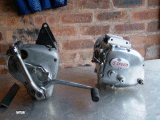
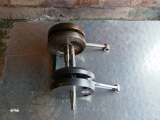
FOUR AND FIVE SPEED BOX LONG THROW AND NORMAL CRANK
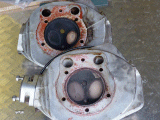
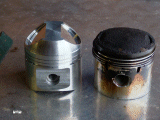
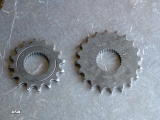
BIG VALVE HEAD FORGED PISTON 20 TOOTH SPROCKET
Once again, the Bullet Gremlin struck. The piston shown above had been manufactured incorrectly. Instead of giving a compression ration of around 8:1 it gave something approaching 13:1 No way could I get the engine to run without pinking - I tried retarding the timing and re jetting the carburettor, all to no avail. We eventually put a compression tester in the plug hole and ran the engine on a set of starter rollers. A reading of around 200 pounds per square inch, or thereabouts, usually indicates a compression ratio of around 10:1 - We ran off the scale at 300 p.s.i. All this, combined with the 'kick backs' of the high compression engine managed to strip the teeth off the new oil pump spindle and destroy the worm gear which drives it. This in turn starved the alloy rocker blocks of oil and effectively scrapped them. The company who supplied the incorrect piston could not apologise enough, and replaced all the scrapped parts. I can thoroughly recommend Hitchcocks to any Bullet owner, they've been supplying bits for mine for the last ten years or more. Having obtained the new parts, a little bit of fettling was in order. A set of longer barrel studs, to make allowance for the 3mm spacer beneath the barrel were made, and the crankcases helicoiled to take the new 8mm studs. The oil return grooves in the rocker blocks were widened to take the extra flow from the high capacity pumps - the ones supplied are already modified, but I thought a "belt and braces" approach was better than having the whole plot hydraulically lock. With the spacer under the barrel and the piston fitted, we then measured the capacity of the combustion chamber. I never thought I'd find a use for a burette again once I'd sat through my last chemistry lesson at school - shows how wrong you can be. 86cc was the capacity of the combustion chamber. The new long throw crank has a stroke of 103mm, and the piston is 84mm diameter. According to my maths ( which has never been my strong point ) this gives a swept volume of 571cc. Add the capacity of the combustion chamber = 657cc. Now divide this by the capacity of the combustion chamber, and the result should be the compression ratio. 7.5 : 1 as near enough.
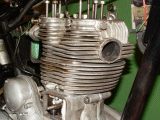
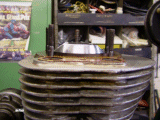
BARREL SPACER THE "INTRUDER"
The rest of the assembly went according to the book - and the engine fired up first kick. Following a test run, we put the compression tester back in the spark plug hole and ran the starter rollers. This time it read 250 psi - which was a tad higher than we thought for a compression ratio of around seven and a half to one, but the engine ran with no sign of pinking. I dare say a bit of fettling with the timing and the carburettor will get things just right.
That brings us up to October 2007 - who knows what lies in store over the next sixteen years ?
Update time . . . and it's now October 2012 . . . and the Bullet has given no trouble.
All I've had to do was fit an original type seat back on so that I can ride it following the accident.
2013
Well here we are at the end of 2013 - the only thing relevant is that I spent £38 on a new front tyre, oh I tell a lie - it broke an exhaust mounting bracket whilst up at Ladybower Reservoir, and that didn't stop me riding back home . . . where it was soon fixed.
2014
So far this year the Bullet has been trouble free. I did have to take it off the road for a couple of months, but this was due to not having the funds to tax and MOT the bike - still, it's all happy and legal again now - and running quite nicely.
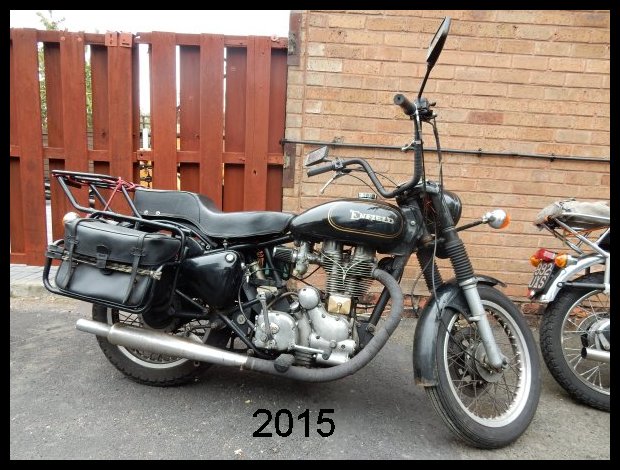
September 2015
Apart from fitting a few brass bits of bling, the Bullet has just got on with doing what a Bullet does best.
September 2016
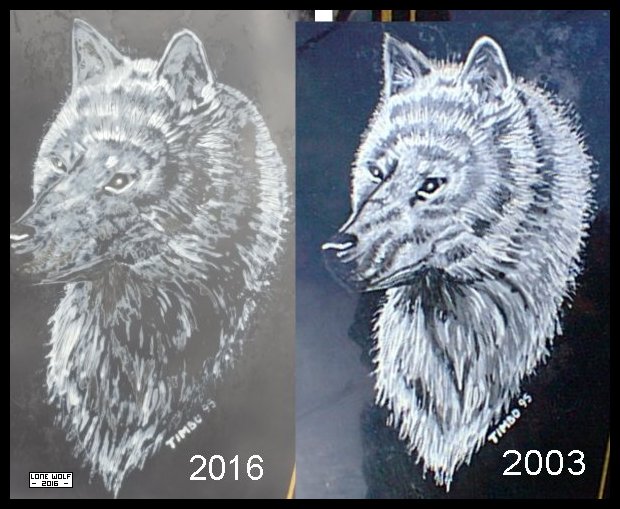
As you can see, polishing can be detrimental to your paintwork.
I do have a spare brand new tank which I may use whilst I try and find someone who can restore the paintwork.
The fellow who did the original work, Tim, has not been seen for a good many years.
August 2017
The Bullet has only been out once so far this year. I've taken the petrol tank off with a view to getting it put back to how it once looked, or maybe have something else . . .I don't know yet.
Luckily I bought a brand new tank a few years ago - this is now on the Bullet whilst I make my mind up what to do with the original. As you can see the current tank has got "Royal Enfield" painted on it - the original only had the word "Enfield" - this was 'cos India and the U.K. were not on speaking terms, so as a "punishment" they were not allowed to use the prefix "Royal" on their machines.
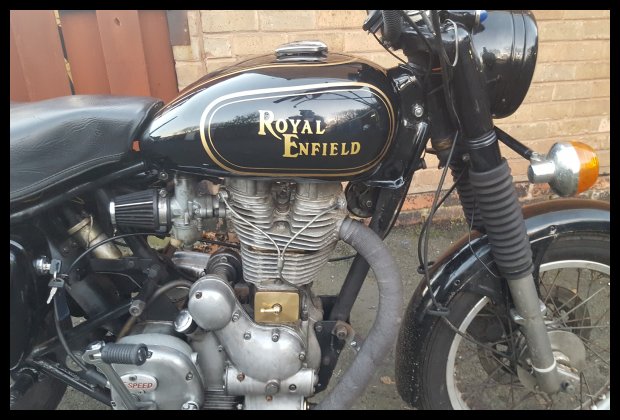
August 2018
The Bullet has had a bit of a relaxing year. A new rear tyre was fitted, and as a special treat it went to Morrisons to pick up my shopping. Oh the life of a "ruffty-fuffty" biker.
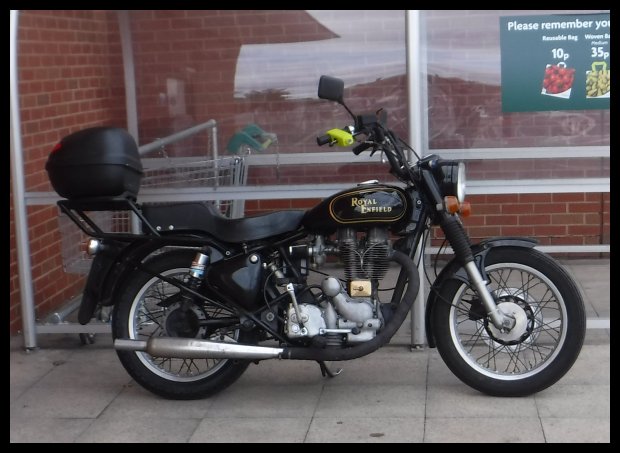
October 2019
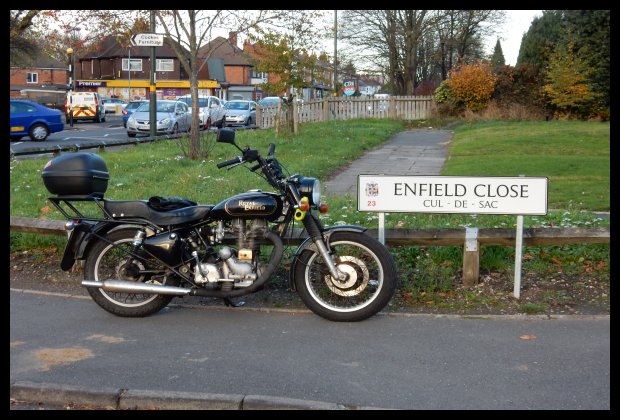
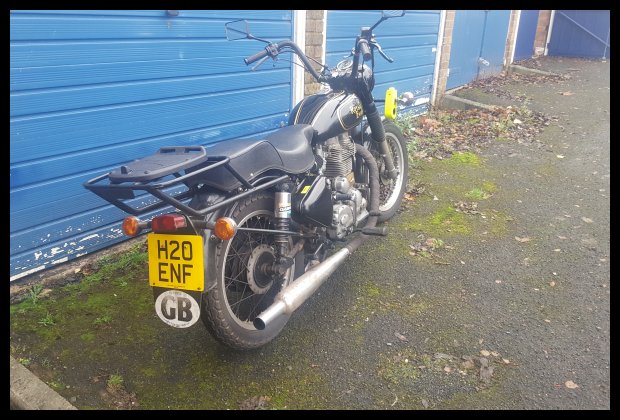
This year the Bullet has had a bit of money spent on it. Due to the advance and retard unit wearing out ( it was still the original Indian one ) I fitted electronic ignition. The carburettor was also rather worn in the slide department, so a new Amal "Premier" Concentric was fitted. Just for the sake of it, the Bullet now has a different registration number - if nothing else it makes it easier for me to remember.
August 2020
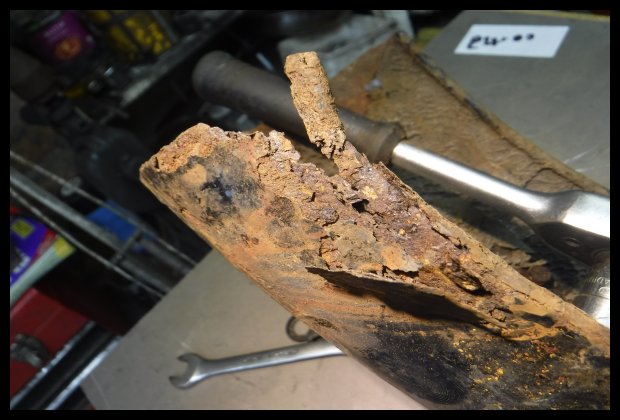
The dreaded rust made an appearance - to the point where powder coating was not going to fix the problem . . . so a new rear mudguard was bought, which promptly went for powder coating along with most of the back end of the bike. Just so the front end didn't feel left out, I bought it a windscreen.
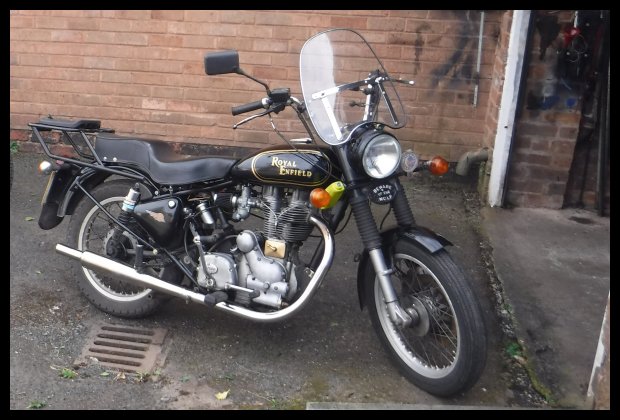
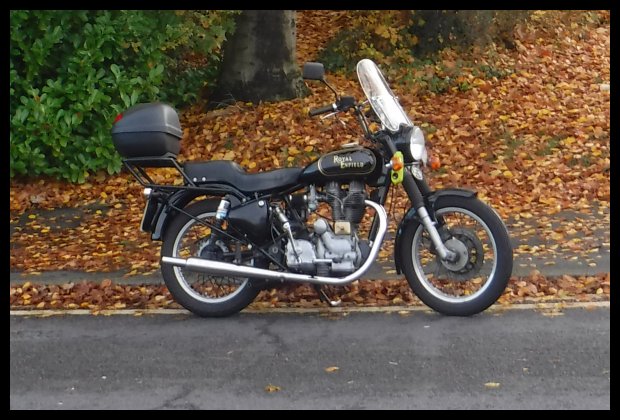
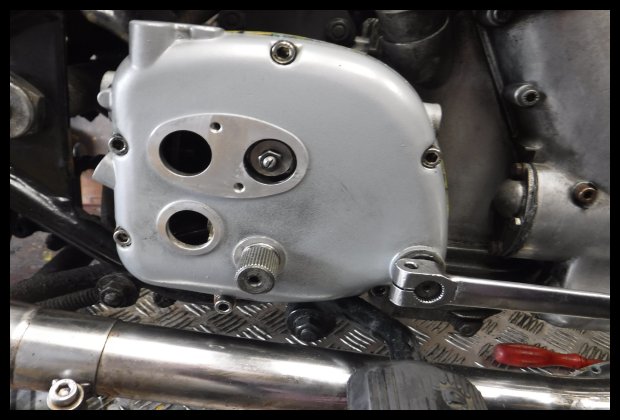
Whilst riding around near Bromyard, the throttle cable snapped. This wasn't a problem as I carry spare throttle and clutch cables, along with the tools to fit 'em. Kneeling down in order to fit 'em is another matter thanks to this bloody injury. . . . but there's always a way. The clutch cable, obviously being jealous of all the attention the throttle cable was getting, decided it too wanted to fray. Now there's a known problem with the clutch cables on the early five speed gearboxes, and those nice people over at Hitchcocks do an uprated gearbox outer cover which solves this problem. So it was over to Hitchcocks to buy one, then back home to fit it - then off out on the bike once more.
December 2021
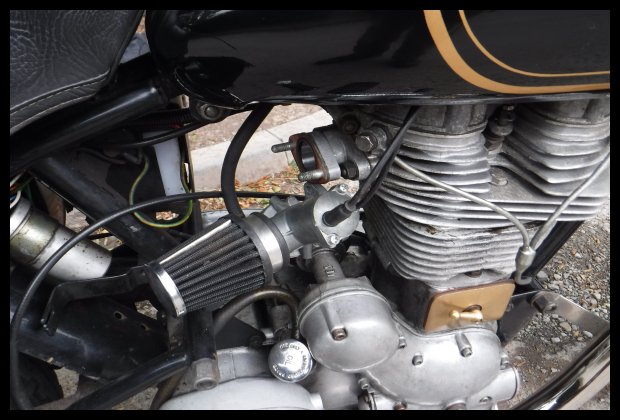
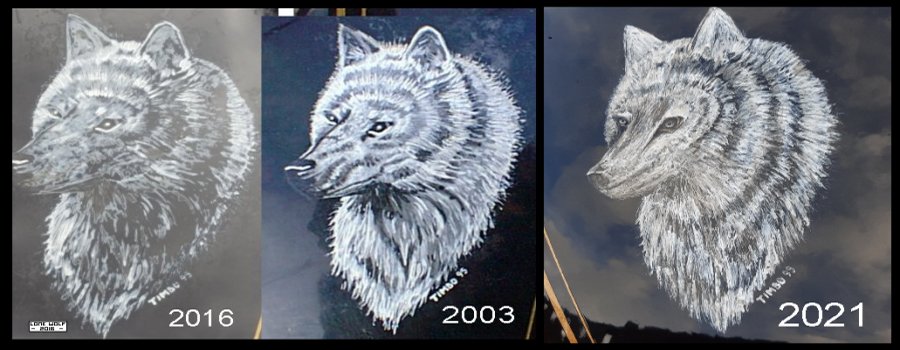
Remember back in 2016 when I said polishing is detrimental to your paintwork ? Well to save you scrolling back up there, have a look below. I took the tank over to Lee, the fellow who does all of my paintwork, and asked if he could "do anything" with it, but keep it more or less original. Well it came back looking a damn sight better than it did. Careful with the polish in future.
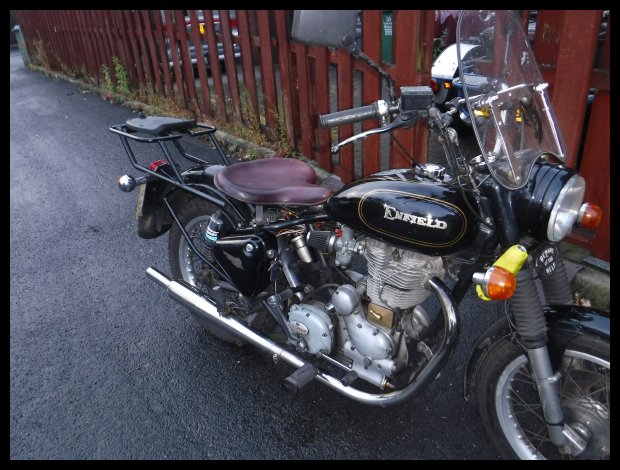
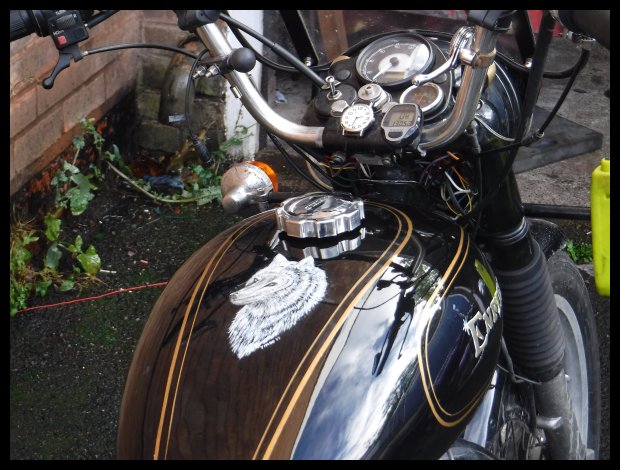
At the same time as the TCT seat was getting recovered, I dropped the Bullet seat in. The cover was just starting to split, so I thought get the two done at the same time. For a short while I re-fitted the large leather "Indian Chief" seat. I had to remove the springs from it because I could no longer lift my leg high enough to climb on board - something else to thank this injury for. Apart from that, the Bullet has just got on with being a Bullet. I suppose the next thing will be fitting a new piston to get rid of the awful piston slap - but whilst it may be annoying, it does mean there's little chance of seizing it up.
November 2022
Back in 2020 I fitted the modified gearbox outer cover ( see 2020 above ). This worked well until I rolled up at West Bay, in Dorset, and pulled the clutch in. I felt something snap. Thinking it was the cable, I wasn't too worried 'cos I carry spare cables. Sadly it wasn't the cable but the clevis on the clutch release unit. It wasn't a roadside fix, so I ended up on the AA van and trailer back to where I was staying over at Porlock. I bought a new clutch release unit and noticed the clevis was made of thicker steel - maybe they were aware of this problem ? I decided to go one better and a new clevis was made - this one being as thick as the clutch operating arm itself. I have a feeling this one will not be breaking any time soon . . . . . and that was the only little niggle that I've had with the Bullet this year.
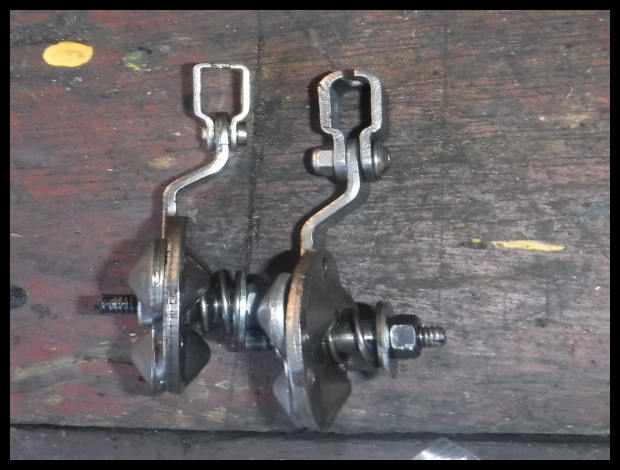
The replacement on the left - the new heavy duty on the right.
November 2023
This year and the Bullet has just been there whenever I needed it. OK - so it's still got awful piston slap, but it's had that since 2007. Oh - I reverted back to the old magnetic type speedometer 'cos the electronic Daytona one was playing up, and it was just easier to swap back than to fault find.
November 2024
A bit of an eventful year for the Bullet. In July I headed to the Lake District for a few days, and whilst up there I managed to come off the bike when climbing the Hardknott Pass. A broken indicator and a broken front brake lever was the result - and a few rather bruised ribs. A temporary repair meant I didn't have to abandon my holiday and the bike was soon fixed when I got back. The following week however, the big end went. The Bullet is currently sitting in the corner of the garage awaiting repair - the reason it's waiting is the fact that the A10 is undergoing a full engine rebuild ( and a few other things ) and I don't really want two bikes in a thousand pieces. I dare say the Bullet will get sorted early next year, if not before.
October 2025
Oh dear, due to my left hip joint having been removed and a temporary one fitted, I've not been able to ride anything with two wheels yet this year - so there's not much point in getting the Bullet back up and running. As much as I'd like to things all sorted, I'm not physically capable of getting the bike up on the bench and removing the engine.
If you are thinking of getting an Enfield, all I can say is
" Go for it"
If nothing else, it will teach you about the more 'relaxed' approach to biking.
Click the tank badge to return from whence you came..

^..^